

MD&A · 2025
In this section4 topics
Overview of Operations
Overview of Operations
1. Overview
Summary of Key Operating Performance for the Year 2025
The Company reported total revenue of Baht 4,801.7million in 2025, decreasing by Baht 676.3million, or 12.3%as a result of lower collections from non-performing assets (NPA). Revenue from the non-performing asset management business remained the Company’s core source of income, accounting for approximately 89%f total revenue.
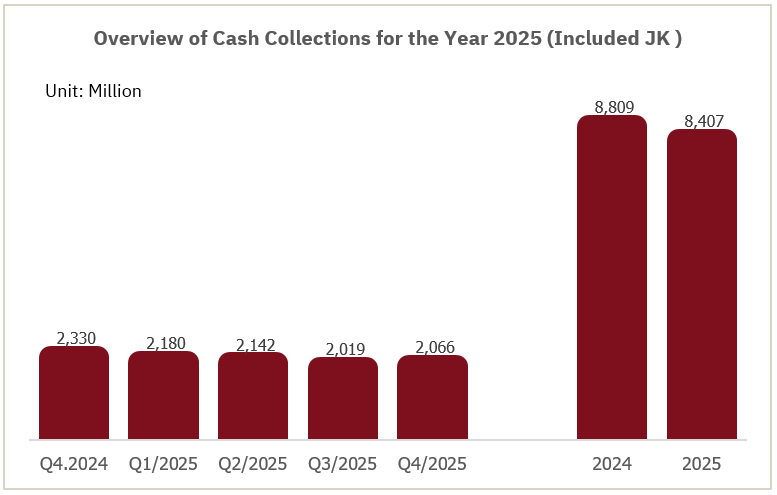
The Company recorded an improvement in cash collections in the fourth quarter of 2025compared with the third quarter of 2025. Total cash collection, including collections from JK Asset Management Company Limited (“JK”), amounted to Baht 2,066million in 4Q2025, representing an increase of 2%from 3Q2025. For the full year 2025, total cash collection amounted to Baht 8,407million, comprising Baht 5,090million from the Company, decreasing by 9%year-on-year, and Baht 3,317million from JK, decreasing by 5%year-on-year.
In 4Q2025, the Company recognized expected credit loss (ECL) provisions of Baht 181.7million, which is a non-cash item. The provision decreased from the previous quarter due to improved cash collection management. The Company aims to gradually reduce ECL levels in each quarter throughout 2026.
In 2025, the Company invested Baht 435 million in non-performing assets, almost entirely in unsecured NPA portfolios.
During 2025, the Company fully repaid debentures totaling Baht 6,376million using internal cash flows and new debenture issuances. For 2026, debentures amounting to Baht 2,413.6million will mature within the next year. The Company expects sufficient operating cash flows to meet its debt repayment obligations and therefore does not anticipate any liquidity concerns. This will also allow the Company to consider increasing investments in non-performing assets going forward.
Net profit attributable to equity holders of the Company for 2025was Baht 1,030million, representing a decrease of 36% compared with 2024.
Economic and Industry Environment Overview
The Thai economy in 2025 was estimated to expand within the range of 2.4%–2.6%, primarily supported by the gradual recovery of exports and tourism. However, during the second half of the year, domestic economic conditions remained under pressure from weak household purchasing power, in line with the slowdown in the global economy. As a result, private consumption expanded at a limited pace and has yet to fully return to its potential level.
Household debt vulnerability remained a key structural constraint on the Thai economy. Although the household debt-to-GDP ratio declined to approximately 87.2%, reflecting more cautious borrowing behavior among households and tighter lending standards by financial institutions, the debt service ratio (DSR) remained elevated relative to household income, which grew at a slower pace than inflation. Consequently, debt servicing capacity among retail borrowers and small and medium-sized enterprises (SMEs) remained fragile, requiring close monitoring of credit risk.
In terms of asset quality within the commercial banking system, non-performing loans (NPLs) remained at elevated levels, particularly in retail lending, auto hire-purchase loans, and household-related credit segments. Financial institutions therefore continued to focus on prudent asset quality management through debt restructuring measures under the guidelines of the Bank of Thailand, alongside tighter control of new NPL formation. As a result, the supply of non-performing assets available for sale in the market became more limited and selective compared with previous economic downturn cycles.
At the same time, overall debt collection performance across the system showed signs of moderation in line with weakened purchasing power. Although NPL inflows remained relatively high, commercial banks adopted a cautious approach in selling distressed assets from their balance sheets, prioritizing balance sheet stability and capital management. Consequently, while transactions in the non-performing loan (NPL) market continued throughout 2025, the volume of new assets entering the market did not increase significantly.
From a public policy perspective, government measures in 2025 continued to focus primarily on stabilizing household financial conditions through programs such as the “Debt Clinic Plus” initiative and sustainable debt restructuring measures. These initiatives played an important role in mitigating default risks and reducing pressure on the financial system. Nevertheless, such measures have not fully addressed structural household debt issues, given constraints from slow income growth and persistently high living costs.
In addition, government support measures for the real estate sector, including the extension of reduced transfer and mortgage registration fees through the end of 2025, provided partial support to the disposal of non-performing assets (NPAs) by asset management companies amid a challenging economic environment. Overall, while the debt collection business continued to face pressure from weaker purchasing power, the prevailing environment remained strategically important for disciplined investment in quality distressed assets at appropriate pricing, supporting long-term portfolio growth.
Improvement Plan to Achieve Target Performance
Based on the operating results for the fourth quarter of 2025 and the full year 2025, the Company’s performance declined at a lower rate compared to the same period last year. To ensure proactive management and enhance operational efficiency, the Company has implemented key measures as follows:
Revenue Enhancement Measures (Increasing Collections and Generating Income)
Amid the economic slowdown, which has affected debtors’ repayment capacity, the Company has focused on maintaining portfolio quality while keeping Expected Credit Loss (ECL) at an appropriate level. This has been achieved through debtor assistance measures targeting customers who continue to demonstrate willingness and potential to repay, including debt restructuring in line with current income levels, extension of repayment periods, installment reductions, and temporary partial payment relief.
At the same time, the Company has increased efforts to promote account settlements through special settlement discounts in order to accelerate cash inflows, reduce long-term credit risk, and enhance overall collection efficiency. The Company also plans to increase the use of legal enforcement processes in 2026 to further strengthen collection effectiveness.
Cost Optimization Measures (Reducing Operating Costs without Affecting Business Performance)
The Company has continued to optimize its cost structure without compromising operational capabilities, with a focus on leveraging AI technology in debt collection processes and quality control, alongside workforce optimization aligned with its long-term strategic plan. AI applications have already been implemented in several key initiatives, including OCR technology and an AI-based Quality Monitoring System, which have contributed to improved operational efficiency and a tangible reduction in unit costs.
Cash Flow Management and Capital Structure Measures
The Company has conducted prudent financial planning covering both operating activities and investments in non-performing asset acquisitions to ensure alignment between cash flows and future debt obligations. In 2025, the Company fully repaid all maturing debentures as scheduled. For 2026, the Company maintains sufficient excess liquidity to support ongoing operations and future growth initiatives.
Operating Results & Financial Condition
Operating Results & Profitability
2. Operating performance and profitability
Total Income
The Company reported total revenue for the year 2025 of Baht 4,801.7 million, representing a decrease of Baht 676.3 million, or 12.3%, compared with the previous year. The details of changes in revenue are as follows:
Revenue from contracts with customers for the year 2025amounted to Baht 225.5million, decreasing by Baht 89.2million, or 28.3%, from the previous year. The primary reason is that financial institutions have shifted their focus toward internal debt restructuring before outsourcing, resulting in a decrease in the volume of debt collection service assignments. Nevertheless, the Company remains focused on maintaining a strong relationship with its existing client base. Currently, the revenue share from the debt collection service business accounts for only 4.7%f total revenue.
Interest income, dividend income, and interest income from purchased receivables for the year 2025amounted to Baht 4,266.8million, decreasing by Baht 417.1million, or 8.9%, compared with the previous year. The decrease was mainly attributable to lower cash collections from non-performing asset portfolios, primarily due to the continued slowdown in domestic economic conditions and elevated household debt levels.
Insurance underwriting income for the year 2025amounted to Baht 309.5million, decreasing by Baht 169.8million, or 35.4%, compared with the previous year. The decrease was primarily due to the Company’s focus on underwriting insurance products with lower loss ratios, resulting in a more selective underwriting approach aimed at better risk control.
Cost of Services
The Company reported cost of services for the year 2025 of Baht 1,423.3 million, representing a decrease of Baht 146.3 million, or 9.3%, compared with the previous year. The decrease was mainly attributable to a reduction in the number of employees during the second quarter of 2025, as well as lower legal expenses. This resulted from the Company’s adjustment of its debt collection strategy to focus legal actions on debtor groups with underlying assets, thereby enhancing enforcement efficiency while optimizing cost management.
Insurance costs
The Company reported insurance costs for the year 2025 of Baht 341.3 million, representing a decrease of Baht 173.9 million, or 33.8%, compared with the previous year. The decrease was in line with the reduction in insurance underwriting income.
Gross Profit
The Company reported gross profit based on the consolidated financial statements for the year 2025 of Baht 3,037.1 million, representing a decrease of Baht 356.2 million, or 10.5%, compared with the previous year. The decrease was primarily attributable to lower total revenue. Nevertheless, the Company was able to maintain profitability efficiency, with the gross profit margin showing a slight improvement compared with the previous year.
Administrative Expenses
The Company reported administrative expenses for the year 2025 of Baht 752.7 million, representing a decrease of Baht 115.5 million, or 13.3%, compared with the previous year. The decrease was mainly attributable to more stringent and effective expense control measures to ensure that operating expenses were aligned as closely as possible with the level of total revenue. The Company implemented expense management across all areas, including marketing expenses, personnel expenses, and other administrative expenses.
Expected Credit Loss (ECL)
The Company recorded expected credit loss (ECL) expenses for the year 2025 amounting to Baht 891.4 million, representing an increase of Baht 278.5 million, or 45.4%, compared with the previous year. The increase was primarily due to additional credit loss provisions for debt portfolios with collection performance lower than previously estimated, resulting from an economic environment that remained unfavorable. The Company continues to apply conservative assumptions in its assessment to ensure that the provisioning appropriately reflects actual credit risk and remains suitable under current conditions.
ECL is a non-cash item. The Company believes that if economic conditions return to normal, the level of credit loss provisioning is expected to decline accordingly.
Net Profit Attributable to Shareholders
The Company reported net profit attributable to equity holders of the Company for the year 2025 of Baht 1,029.6 million, representing a decrease of Baht 585.6 million, or 36.3%, compared with the previous year. This was due to a decrease in total revenue, combined with an increase in Expected Credit Loss (ECL). Additionally, JK Asset Management Co., Ltd. also recognized ECL provisions to cover risks associated with non-performing loan collections, resulting in a decrease in the share of profits from joint ventures.
Key Financial Ratio
Key Financial Ratio | 2024 | 2025 |
Current ratio (times) | 0.70 | 1.37 |
Gross profit margin (percent) | 61.94 | 63.25 |
Operating profit margin (percent) | 36.89 | 32.34 |
Net profit margin (percent) | 29.81 | 21.17 |
Return on Equity (ROE) (percent) | 7.35 | 5.59 |
Return on assets (ROA) (percent) | 4.89 | 3.97 |
Total debt to equity (debt to equity : D/E ratio) (times) | 0.46 | 0.36 |
Interest-bearing debt to equity ratio (IBD/E ratio) (times) | 0.42 | 0.33 |
Calculation of Financial Ratios in accordance with the Notification of the Capital Market Supervisory Board No. TorJor.
14/2024 (No. 27)
*Return on Equity (ROE) = Earnings before interest and tax (EBIT) * 100 / Average total shareholders’ equity
** Return on Assets (ROA) = Earnings before interest and tax (EBIT) * 100 / Average total assets
Liquidity & Capital Adequacy
4. Liquidity and Capital Adequacy
Debt Servicing Ability and Compliance with Loan Covenants
As of 31 December 2025, the Company had debentures maturing within 2026 totaling Baht 2,413.6 million. The Company has carefully prepared liquidity and capital structure management plans to support such obligations, both through operating cash flows and access to funding sources at appropriate costs. The Company continues to maintain a strong financial position and has consistently complied with all financial covenants under its debenture agreements
Liquidity and Cash Flow Analysis
For the year 2025, the Company reported a net decrease in cash and cash equivalents of Baht 494.4 million. Details of cash flows from each activity are as follows:
Unit : Million Bath | 2024 | 2025 |
Cash flow from operating activities | 1,365.7 | 3,039.0 |
Cash flow from (used in) investing activities | 630.8 | (236.7) |
Cash flow from (used in) financing activities | (2,681.2) | (3,296.6) |
Net increase (decrease) in cash and cash equivalents | (684.7) | (494.4) |
Cash flows from operating activities amounted to Baht 3,039.0 million, representing an increase of Baht 1,673.3 million, or 122.5%, compared with the previous year. Despite a decrease in operating profit, the Company reported higher operating cash flows primarily due to significantly lower investments in non-performing loans (NPLs) and non-performing assets held for sale (NPAs) during the period compared with the previous year. In addition, the conversion of certain current financial assets into cash contributed to improved liquidity and increased cash inflows from operating activities.
Cash flows used in investing activities amounted to Baht 236.7 million, mainly comprising three key items: (1) cash received from repayment of loans to related parties amounting to Baht 675 million, (2) cash paid for capital injection in a joint venture amounting to Baht 758 million, and (3) cash paid for the purchase of computer equipment and software amounting to Baht 165 million.
Cash flows used in financing activities amounted to Baht 3,296.6 million, primarily for debenture redemption and repayment of borrowings from financial institutions.
Furthermore, based on the cash flow projections for bond redemptions, the Company confirms that it maintains sufficient liquidity throughout 2026 and is able to pay dividends at a rate of 0.43 Baht per share. The record date to determine the shareholders entitled to receive the dividend is set for March 4, 2026.
Asset Management Capability
3. Asset Management Capability
Asset
As of 31 December 2025, the Company reported total assets of Baht 37,913.2 million, representing a decrease of Baht 2,374.4 million, or 5.9%, compared with the end of 2024. The decrease was mainly attributable to a reduction in purchased receivables.
Key Components of Assets
Purchased receivables expected to be collected after more than one year amounted to Baht 18,390.1 million, representing 48.5% of total assets. This decreased by Baht 1,941.0 million, or 9.5%, from the end of 2024. The decrease was mainly attributable to expected credit loss (ECL) provisioning and the reclassification of certain debtors into non-performing assets held for sale (NPA).
Investment in joint venture amounted to Baht 6,859.9 million, representing 18.1% of total assets, increasing by Baht 961.0 million, or 16.3%, from the end of 2024. The increase was primarily due to the Company’s capital injection in proportion to its shareholding of approximately Baht 750 million and an increase in accumulated share of profit of approximately Baht 200 million in JK Asset Management Company Limited.
Non-performing assets held for sale (NPA) amounted to Baht 3,035.1 million, representing 8.0% of total assets, increasing by Baht 255.7 million, or 9.2%, from the end of 2024. The increase was mainly attributable to additional investment in certain NPA portfolios, as well as the reclassification of certain assets from non-performing loans (NPLs) to NPAs.
Liabilities and Shareholders’ Equity
As of 31 December 2025, based on the consolidated financial statements, the Company reported total liabilities of Baht 9,996.5 million, representing a decrease of Baht 2,641.2 million, or 20.9%, compared with the end of 2024. The decrease was mainly attributable to the repayment of debentures during the year totaling Baht 6,375 million, partially offset by new debenture issuances amounting to Baht 4,162 million.
The Company reported total shareholders’ equity as of 31 December 2025 of Baht 27,916.7 million, representing a slight increase of 1% compared with the end of 2024.
Debt Obligations & Off-Balance-Sheet Management
5. Debt Liabilities and Management of Off-Balance Sheet Obligations
Commitments under operating lease and service agreements. As of 31December 2025, the Group had minimum future payment obligations under operating lease and service agreements related to short-term leases, leases of low-value underlying assets, and service contracts totaling Baht 13million.
Capital expenditure commitments. As of 31 December 2025, the Company had capital expenditure commitments totaling Baht 4 million, relating to construction supervision and building design contracts, as well as the installation of computer software systems.
Debt Securities with Financial Ratio Requirements
Debt Securities with Financial Ratio Requirements Issued?
No
Factors That May Affect Financial Condition
Factors or Incidents That May Materially Affect Financial Condition
6. Factors Affecting Future Performance (Forward Looking)
In recent periods, the Bank of Thailand (BOT) has implemented policy measures aimed at alleviating household debt burdens, particularly in addressing non-performing loans (NPLs) with outstanding balances not exceeding Baht 100,000 per account. The objective of these measures is to reduce financial burdens for retail borrowers affected by the economic slowdown and to support overall financial system stability. Such measures represent an important short-term social initiative and have contributed to easing credit quality pressures in certain segments of the financial system (Source: Bank of Thailand – Retail Debtor Assistance Measures and Financial Stability Report).
However, data from the Bank of Thailand indicates that the structure of non-performing loans within Thailand’s financial system continues to be largely concentrated in accounts with outstanding balances exceeding Baht 100,000 per account, representing a significant proportion of the overall NPL portfolio. While measures targeting smaller-value retail debt have helped reduce the number of problematic accounts to some extent, they have not fully addressed structural NPL issues, particularly in the context of gradually recovering household purchasing power and debt repayment capacity.
The Company recognizes these challenges and remains prepared to cooperate with government authorities and regulatory agencies in managing retail non-performing loans effectively. Leveraging its experience and expertise in distressed asset management, debt collection, and debt restructuring tailored to individual repayment capacity, the Company continues to enhance recovery efficiency through the application of technology and data analytics. This approach aims to improve debt recovery outcomes while reducing losses within the overall financial system, in line with the Bank of Thailand’s policy direction of utilizing market mechanisms and specialized asset management expertise in managing risk assets.
In addition, the Company has strengthened its capital readiness, financial structure, and human resources to support opportunities arising from the gradual sale of non-performing loan portfolios by financial institutions in the period ahead. Such opportunities are expected to increase in line with government policy directions aimed at reducing balance sheet risks of financial institutions and strengthening long-term financial system stability. The Company believes that operating under this collaborative framework will contribute to an efficient, transparent, and sustainable debt management mechanism that balances consumer protection with the long-term economic stability of the country.
Projects or R&D Affecting Future Results
None